
"How's Sloane feeling about scans tomorrow?"
That was the text from my best friend this morning.
I wrote back: "She's totally fine!"
And that's the truth. It's what I say almost every time someone asks how Sloane's feeling about anything cancer-related. In three years, I can count on one hand the times she's actually been angry, sad, or anxious about it.
Not because we avoid the topic. Quite the opposite.
WE ARE A FAMILY WHERE NOTHING IS OFF THE TABLE. LITERALLY.
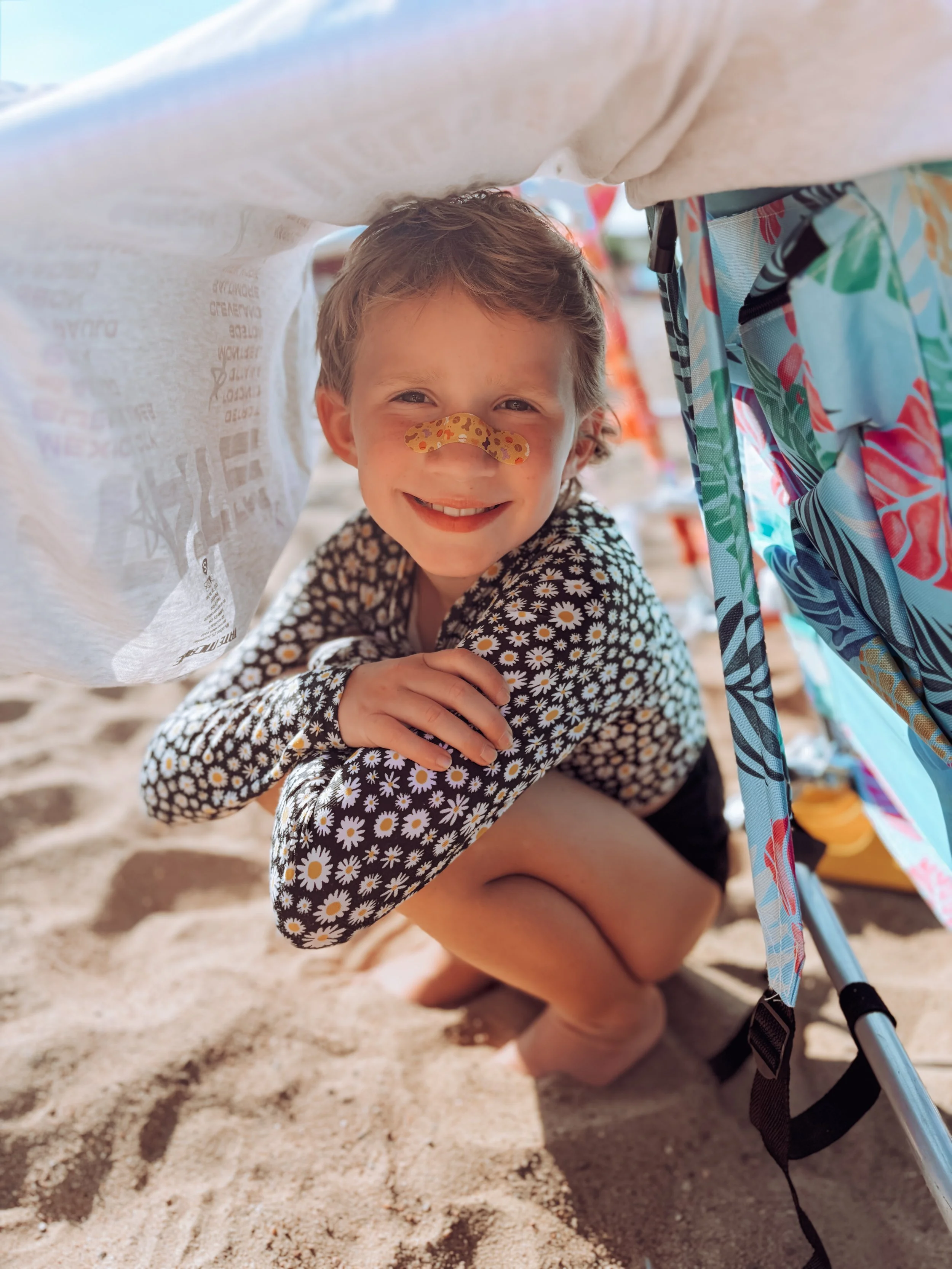
We are a family of communicators. Cancer, death, fear, grief — none of it is off limits in our house. We don't shy away from hard conversations, and we've never shied away from the good, awkward, or uncomfortable ones either.
Case in point: when Indy was wrapping up her health unit at school, my husband felt comfortable enough to sit down and teach her all about puberty himself. Not because the school didn't cover it. Because that's just who we are. If it's a real thing happening in her life, it gets talked about — plainly, honestly, without flinching.
So when I say Sloane doesn't carry much anxiety about cancer, it's not because we've protected her from the topic. It's because she's had years of practice feeling things fully, out loud, in a house where that's always been safe to do.
The Statement Everyone Uses
"Kids are just so resilient."
I've heard this more times than I can count over the last three years. And it's true. I hate that they have to be — no child should need this kind of resilience — but they are.
Watching Sloane, though, I've started to think we’ve gotten resiliency wrong.
We treat it like a bounce. Like something happens, you get knocked down, and resilience is the spring in your step that gets you back up and moving forward again. Growth as the finish line. Healing as the destination.
But Sloane isn't bouncing back from anything. She can't. There is no "back" to bounce to — no version of her life where cancer didn't happen, no clean before-and-after. And there's no guaranteed "forward" either. She lives inside a statistic where relapse can mean the survival rate drops below 10%. We know that. And part of me thinks she's starting to know that too.
So what does her resilience actually look like, if it's not bouncing back and it's not growing forward?
It looks like today. Just today.
Not Bad, Not Good. It Just Is.
Sloane isn't hung up on the past. She isn't spiraling on the what-ifs of the future. She's here — focused on this day, this moment, whatever it holds.
She's learned to accept that this journey isn't bad, isn't good. It just is.
I used to think that sounded like surrender, in a bad way. Now I think it's the most active, effortful thing I've ever watched a person do. She is choosing, every single day, to meet whatever today brings without needing it to be resolved first. Without needing the scan results, the all-clear, the ending.
That's the piece I got wrong for so long. I kept waiting for resilience to be a phase — something you build through hard times so you can eventually get to the other side of them. But some hard things don't have another side. The hard, for us, may never fully end.
And if that's true, then resilience can't be a one-time climb out of a hole. It has to be something you rebuild every morning, whether or not yesterday's hard is resolved.
This Is the Book
This is the thing I keep coming back to as I write.
Resilience isn't the muscle you build once during a crisis and then carry with you forever, healed. It's not a before-and-after story. It's a daily decision — sometimes an hour-by-hour one — to find happiness in the hard, because the hard isn't going anywhere on its own timeline.
Sloane didn't learn this because someone taught her a framework. She learned it because we never made any part of her story unspeakable, and because somewhere along the way, she stopped waiting for the story to be over before she let herself be happy inside it.
She's eight (nine in September). She has taught me more about this than any book I've read while trying to write my own.
I don't know when — or if — I'll ever fully believe cancer is behind us. But I'm learning, the way she has, that today doesn't need me to know that in order to be a good day.
That's not bouncing back. That's not growing forward.
That's just resilience — practiced again, tomorrow, and the day after that.